
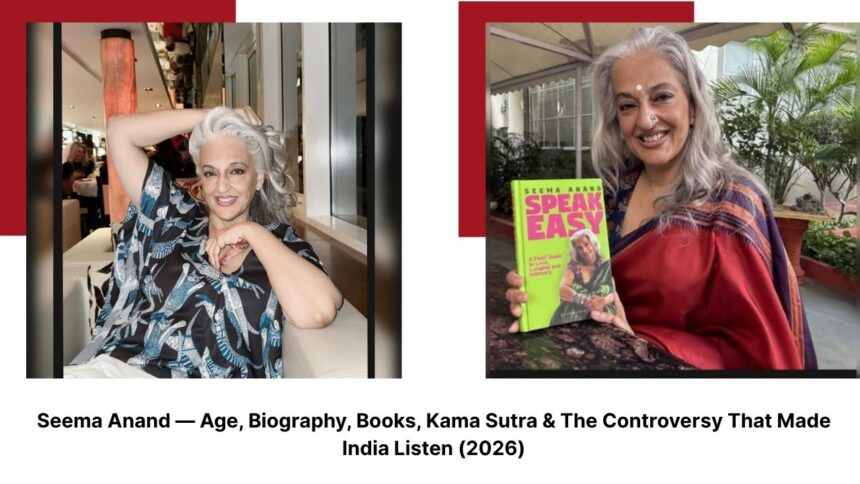
Seema Anand
Quick Info: Hometown: London, UK (originally Delhi, India) | Age: 63 Years | Profession: Mythologist · Storyteller · Author · Sex Educator · Corporate Trainer
- Early Life — Delhi, Tragedy & The Move to London
- The Academic & Institutional Career — UNESCO, British Museum & FRSA
- The Book & The TEDx Talk — How She Reached 8 Million People
- The Controversies — Podcast Clip & The Teenage Boy Incident (January 2026)
- Lesser Known Facts About Seema Anand
- 3 Things Most Articles About Seema Anand Miss
- FAQ — What People Are Searching About Seema Anand
| Full Name | Seema Anand |
| Husband | husband’s identity not publicly disclosed, You might see names like “Akarsh Sinha” floating online (mostly on Instagram reels or unverified pages).There is no credible source confirming this |
| Profession | Mythologist · Narrative Practitioner · Author · TEDx Speaker · Sex Educator · Corporate Trainer |
| Date of Birth | August 18, 1962 |
| Age (as of 2026) | 63 Years |
| Birthplace | India (exact city not publicly specified) |
| Current Base | London, United Kingdom |
| Nationality | Indian (London-based) |
| Religion | Hindu |
| Education | BA — Delhi University; PhD in Narrative Practices — London |
| Academic Fellowship | Fellow of the Royal Society of Arts (FRSA) — alongside Charles Dickens, Karl Marx, Stephen Hawking |
| Family | Married — husband’s identity not publicly disclosed; three children |
| Father | Assassinated when Seema was 19 years old — a defining personal tragedy |
| Great-Grandmother | School inspector during British Raj — social activist working against violence towards women |
| Key Book | The Arts of Seduction: The 21st Century Guide to Having the Greatest Sex of Your Life (2018, Aleph Book Company) |
| TEDx Talk | “The Art of Seduction” — TEDxEaling — 8 million+ views |
| UNESCO Affiliation | Research affiliated to UNESCO’s initiative for Preserving Endangered Oral Traditions |
| Institutional Work | V&A Museum, British Museum, National Portrait Gallery, NHS, UK universities, county councils |
| @seemaanandstorytelling — 2 million+ followers | |
| Guinness World Record | Largest rangoli in the world |
| Wellness Centre | Look Beyond India — New Delhi — Director since 1998 |
| Net Worth (est.) | $2–5 million USD — books, corporate training, speaking, digital content |
At 19 years old, Seema Anand’s father was assassinated. That single sentence — buried in most coverage of her work — is the foundation everything else is built on. A young woman who lost her primary male figure to violence grew up to spend the next four decades studying ancient Indian texts that celebrated women’s desire, women’s agency, and women’s pleasure as legitimate philosophy.
That is not a coincidence. That is a life shaped by loss into purpose. And when you understand the personal trajectory, the career that followed — Kama Sutra scholar, UNESCO collaborator, British Museum educator, 2 million Instagram followers, and one of India’s most discussed sex educators at 63 — makes a particular kind of sense.
Early Life — Delhi, Tragedy & The Move to London
Seema Anand was born on August 18, 1962 in India into a family with an unusually strong legacy of women’s education and activism. Her great-grandmother was a school inspector during the British Raj — a woman working in institutional authority at a time when most Indian women had neither education nor public voice. That lineage of strong women shaped Seema’s worldview before she had words for it.
She studied at Delhi University, earning her BA before moving to London in her early twenties. The move itself was a statement — leaving India, which she later described as increasingly pruned of its ancient erotic philosophy, for a Western city that would allow her to study and discuss these subjects with academic legitimacy.
In London, she earned a PhD in Narrative Practices — specialising in women’s narratives and oral traditions. That academic framework became her professional signature: she was not a popular commentator on sex. She was a scholar of the stories surrounding human desire, trained to the doctoral level, affiliated with UNESCO, and commissioned by institutions including the British Museum and the Victoria & Albert Museum.
The Academic & Institutional Career — UNESCO, British Museum & FRSA
The version of Seema Anand that most Indian social media knows — the warm, accessible Instagram educator — sits on top of a decade-long institutional career that most profiles barely mention.
Her research on ancient Indian folklore is affiliated to the UNESCO initiative for Preserving Endangered Oral Traditions. She has developed education resources for the V&A Museum and the British Museum based on ancient Indian narratives. She lectures across London universities, NHS trusts, and UK county councils on Equality, Diversity, and Cultural Competence through the lens of narrative power.
In the corporate sector, she teaches storytelling as a strategic leadership skill — a position that treats ancient oral traditions as directly applicable to modern business communication. That unusual crossover — ancient texts to boardroom strategy — is one of the things that distinguishes her from both pure academics and pure social media educators.
She is a Fellow of the Royal Society of Arts (FRSA) — an honour shared by Charles Dickens, Karl Marx, and Stephen Hawking. The fellowship recognises exceptional contributions to the arts, manufacturing, and commerce. Most Indian profiles of Seema Anand skip this entirely.
The Book & The TEDx Talk — How She Reached 8 Million People
Seema Anand did not become famous because of social media first. She became famous because of ideas first. Her TEDxEaling talk “The Art of Seduction” — delivered years before her Instagram following crossed a million — now has over 8 million views. It remains one of the most-watched Indian-origin TED talks on the subject of ancient erotic philosophy.
The talk argues that the Kama Sutra was not pornography — it was high philosophy. That ancient India treated courtesanship and seduction as legitimate arts with divine and academic associations. That somewhere in the transition from precolonial to colonial to post-independence India, a profound vocabulary of pleasure was lost and replaced with shame.
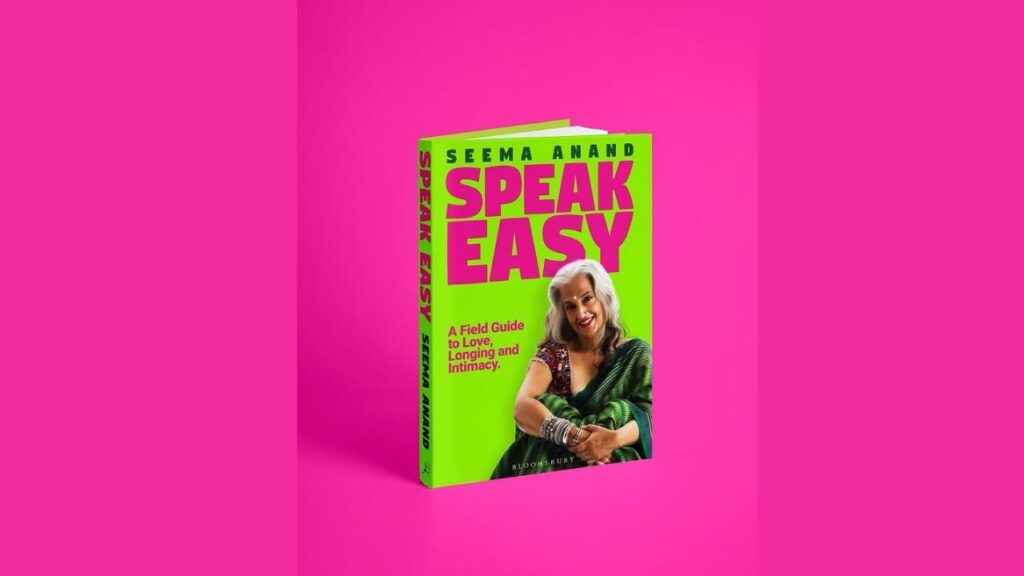
Her book The Arts of Seduction: The 21st Century Guide to Having the Greatest Sex of Your Life (published 2018 by Aleph Book Company) extends that argument into practical territory. Drawing from the Kama Sutra — kissing types, perfume application, massage, love messaging codes — it translates ancient sensual philosophy into accessible modern language without removing either the poetry or the scholarship.
The book was widely reviewed in Femina, India Today, and international publications. Readers on Amazon consistently describe it as “life-changing” and “the only honest Indian book about sex education” — a response that reflects how starved Indian readers are for this kind of material presented without shame or sensationalism.
The Controversies — Podcast Clip & The Teenage Boy Incident (January 2026)
In January 2026, a short clip from a podcast with host Shubhankar Mishra went viral — and not for reasons Seema Anand would have chosen.
During the conversation, Mishra asked her why younger men are sometimes attracted to older women and whether she had personally experienced such attention. Seema responded by recalling an incident from the previous year in which she said a 15-year-old boy had approached her using what she described as “filthy language.” Mishra remarked the boy was “four times younger” than her, to which she confirmed the exchange.
The clip spread rapidly. Critics argued that narrating the incident in a light, conversational tone — on a public podcast — normalised inappropriate behaviour by a minor and that the framing lacked appropriate gravity given the child’s age. Some viewers felt the story was told as an anecdote of flattery rather than as a concern.
What the headlines miss is the full context. Seema Anand did not describe the incident approvingly — she described it as part of a broader discussion on attraction dynamics. But the framing of a podcast conversation — designed to be light and engaging — made the boundary of her intent difficult to read cleanly. She did not issue a formal public clarification beyond responding through her social media presence.
The controversy intensified an existing debate about where the line sits between frank sex education and irresponsible public framing. Her defenders argued it was a moment of context-collapse — a clip severed from a nuanced conversation. Her critics argued that a sex educator of her standing should apply a higher standard of care when minors enter the discussion.
| Category | Academic / Institutional Seema | Digital Creator Seema |
|---|---|---|
| Platform | British Museum, V&A, UNESCO, NHS, FRSA | Instagram (2M+), YouTube, Podcasts |
| Audience | Museum visitors, corporate professionals, academics | Young Indians discovering erotic philosophy |
| Content Style | Lectures, education resources, corporate workshops | Short videos, relationship advice, cultural commentary |
| Key Work | UNESCO oral tradition research, education materials | TEDx talk (8M views), Instagram reels, book |
| Recognition | FRSA fellowship, Guinness World Record | 2M Instagram followers, viral TEDx, India Today features |
| Controversy Risk | Low — institutional framing provides context | High — short clips strip context, create misreadings |
Lesser Known Facts About Seema Anand
- Seema Anand’s father was assassinated when she was 19 years old — a defining personal tragedy that shaped her lifelong focus on resilience, women’s narratives, and reclaiming agency through story.
- Her great-grandmother was a school inspector during the British Raj — actively working against violence towards women in colonial India — establishing a family legacy of women’s empowerment that predates Seema by two generations.
- She holds a Guinness World Record for the largest rangoli in the world — a cultural achievement completely separate from her academic and literary work that demonstrates her range as a practitioner of Indian arts.
- She is a qualified master of Tantric philosophy — not a casual commentator on Tantra but a formally credentialled practitioner of a discipline she also teaches.
- Her TEDxEaling talk “The Art of Seduction” has accumulated over 8 million views — placing it among the most-viewed Indian-origin TEDx talks on human relationships and ancient philosophy.
- She has been Director of Look Beyond India — a New Delhi wellness centre — since 1998, predating her social media career by nearly two decades.
- She is a Fellow of the Royal Society of Arts (FRSA) — a fellowship shared with Charles Dickens, Karl Marx, Benjamin Franklin, and Stephen Hawking — awarded for exceptional contributions to society.
- She developed education resources for the V&A Museum and the British Museum based on ancient Indian narratives — her academic work was commissioned by two of the world’s most prestigious cultural institutions.
- Her work is affiliated to UNESCO’s initiative for Preserving Endangered Oral Traditions — making her research not just academic but officially linked to global cultural preservation.
- She is a Diwali event director for one of London’s largest annual Diwali celebrations — a community organising role that rarely appears in profiles focused on her literary work.
- She teaches Equality, Diversity, and Cultural Competence in the corporate sector through storytelling — her clients include the NHS, UK county councils, and major London universities.
- Her Instagram handle is @seemaanandstorytelling — she frames her entire digital presence as storytelling rather than sex education, a deliberate positioning choice that shapes how her content is received.
3 Things Most Articles About Seema Anand Miss
1. Her FRSA fellowship puts her in the same category as Charles Dickens, Karl Marx, and Stephen Hawking — and almost nobody mentions it. The Royal Society of Arts fellowship is not a vanity award. It is a serious institutional recognition of lifetime contribution. That Seema Anand holds it alongside some of history’s greatest thinkers is a fact that her own coverage consistently buries under “Kama Sutra expert.”
2. The Kama Sutra is not her only text — she lectures across the Mahavidyas, Mahabharata, Bhagavad Gita, Puranas, and Tantric philosophy. Most coverage reduces her to one book and one subject. Her actual academic range covers the full breadth of ancient Indian philosophical and narrative tradition. The Kama Sutra is the access point — not the destination.
3. Her move to London at 23 was an act of intellectual necessity, not just migration. In her telling, ancient India’s erotic philosophy had become unspeakable in the country that produced it. Post-colonial shame had replaced the original philosophical curiosity. London offered her the academic freedom to study these texts without institutional resistance. Understanding that exile — from the culture she was studying — explains the restless urgency of her work.
For more on how India’s ancient philosophical traditions intersect with modern social debates, read our analysis: Chandrashekhar Azad Bhim Army — Biography, Caste Politics & What He Wants.
FAQ — What People Are Searching About Seema Anand
Who is Seema Anand?
Seema Anand (born August 18, 1962) is a London-based Indian mythologist, storyteller, PhD holder in Narrative Practices, author, and sex educator. She is an authority on the Kama Sutra and ancient Indian erotic philosophy, a Fellow of the Royal Society of Arts (FRSA), and is affiliated with UNESCO’s initiative for preserving endangered oral traditions. Her TEDxEaling talk has over 8 million views and her Instagram has 2 million+ followers.
What is Seema Anand’s book?
The Arts of Seduction: The 21st Century Guide to Having the Greatest Sex of Your Life was published in 2018 by Aleph Book Company. Drawing from the Kama Sutra, it translates ancient Indian philosophy of sensuality, pleasure, and seduction into accessible modern language — covering kissing, massage, perfume, love communication codes, and the philosophy of desire. It is widely considered the most accessible scholarly treatment of the Kama Sutra for contemporary Indian readers.
What is the Seema Anand 15-year-old controversy?
In January 2026, a clip from a podcast with Shubhankar Mishra went viral in which Seema Anand recounted an incident where a 15-year-old boy had approached her using explicit language. Critics argued the anecdote was framed too casually given the minor’s age, triggering debate about the responsibility of sex educators when minors enter public discussions. Supporters argued the clip was taken out of context from a broader conversation on attraction dynamics.
What is the Kama Sutra according to Seema Anand?
Seema Anand argues that the Kama Sutra was never pornography — it was ancient Indian high philosophy that treated pleasure, courtesanship, and seduction as legitimate academic and divine disciplines. Her central argument, expressed in both her TEDx talk and book, is that post-colonial shame stripped India of this philosophical tradition and replaced it with prudishness that was imported, not indigenous.
What is Seema Anand’s connection to UNESCO?
Seema Anand’s research on ancient Indian folklore and oral traditions is affiliated to UNESCO’s initiative for Preserving Endangered Oral Traditions. She works to bring ancient Indian texts — translated and reworked for multicultural audiences — back into public space before they are lost. She has developed education resources for the V&A Museum and the British Museum based on these narratives.
Seema Anand built her career in the exact gap that post-colonial India created — the space between the civilisation that wrote the Kama Sutra and the civilisation that was ashamed of it. She has spent four decades filling that gap with scholarship, storytelling, and the patient argument that ancient India knew something about pleasure that modern India has forgotten.
At 63, with 2 million Instagram followers, an FRSA fellowship, and a controversy that reminded India she was still very much in the conversation — she shows no signs of either slowing down or softening her message. The stories are still running. So is she.