
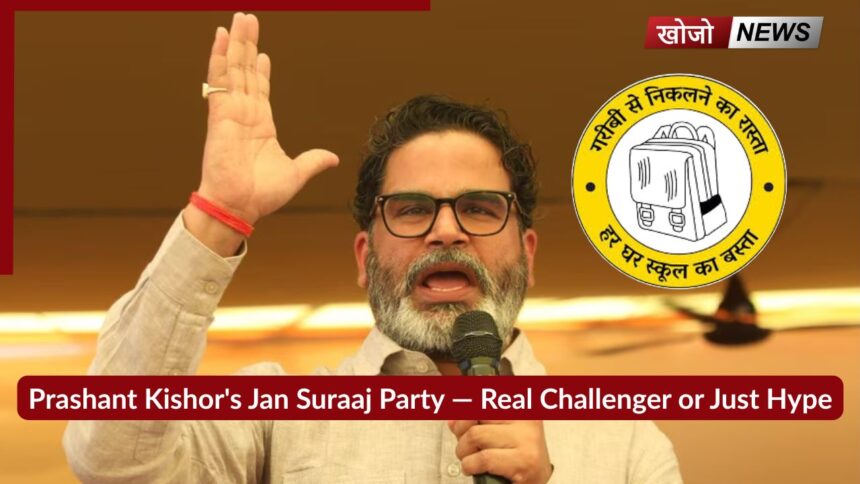
| Party Name | Jan Suraaj Party (JSP) — “People’s Good Governance Party” |
| Founded | October 2, 2024 — Gandhi Jayanti, Patna |
| Founder | Prashant Kishor (PK) — born March 20, 1977, Rohtas, Bihar |
| Before Politics | India’s most successful election strategist — worked for BJP, Congress, TMC, AAP, DMK, YSRCP, JDU |
| Padyatra | 3,500+ km walk across Bihar (Oct 2022 – Oct 2024) — visited 5,000+ villages |
| 2025 Bihar Election — Seats Contested | 238 out of 243 |
| 2025 Bihar Election — Seats Won | 0 (zero) |
| 2025 Vote Share | 3.44% |
| Deposit Forfeited | 236 out of 238 candidates — lost deposits |
| Spoiler Impact | Polled more votes than winning margin in 34 constituencies |
| Post-Election Action | Dissolved entire party structure — panchayat to state level (November 2025) |
| PK’s Own Statement | Said he would retire if JDU won 25 seats — JDU won 85 |
On November 15, 2025, Bihar’s election results came in. Prashant Kishor — the man who made Narendra Modi’s 2014 campaign, who kept Mamata Banerjee in power in 2021, who is arguably India’s greatest election strategist of the modern era — watched his own party win exactly zero seats. Zero. After a 3,500 km padyatra. After two years of village meetings. After contesting 238 out of 243 constituencies.
To make it worse — he had publicly said he would retire from politics if JDU won 25 seats. JDU won 85.
Who Is Prashant Kishor — And Why Does This Failure Sting So Much
Most people get this wrong about PK — they think of him as a politician who was also a strategist. It’s actually the reverse. He is a strategist who tried to become a politician. That distinction matters enormously for understanding what went wrong.
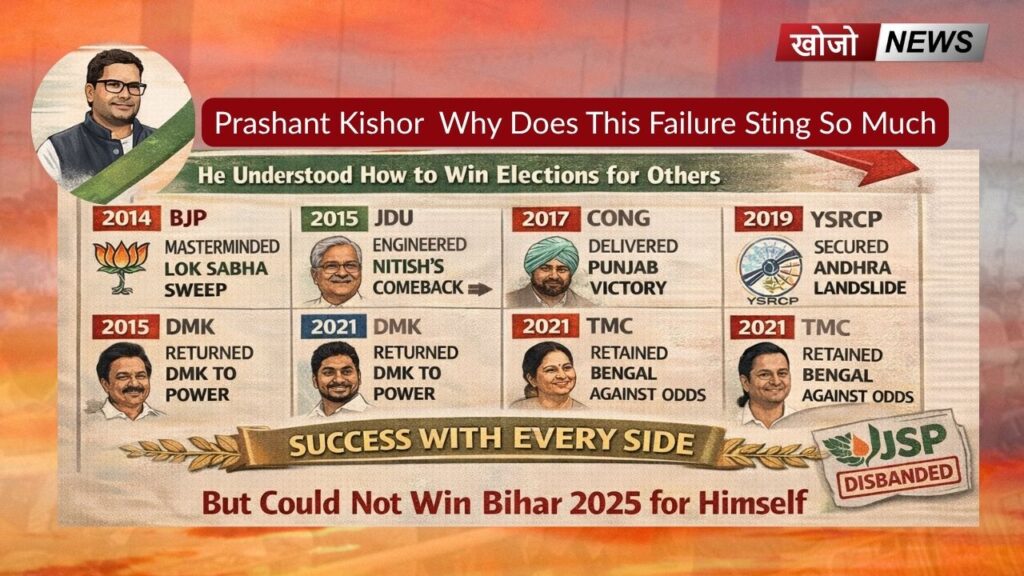
Before Jan Suraaj, Kishor’s track record was extraordinary. He masterminded BJP’s 2014 Lok Sabha sweep, Nitish Kumar’s 2015 Bihar comeback, Congress’s 2017 Punjab win, YSRCP’s 2019 Andhra landslide, DMK’s 2021 Tamil Nadu return, and Mamata’s 2021 Bengal victory despite immense central pressure. Every side of Indian politics, every ideology — he won for all of them.
He understood exactly how elections are won. That’s precisely what makes his Bihar 2025 result so analytically fascinating. The man who knew the formula failed to apply it to himself.
What Jan Suraaj Actually Promised — And What It Delivered
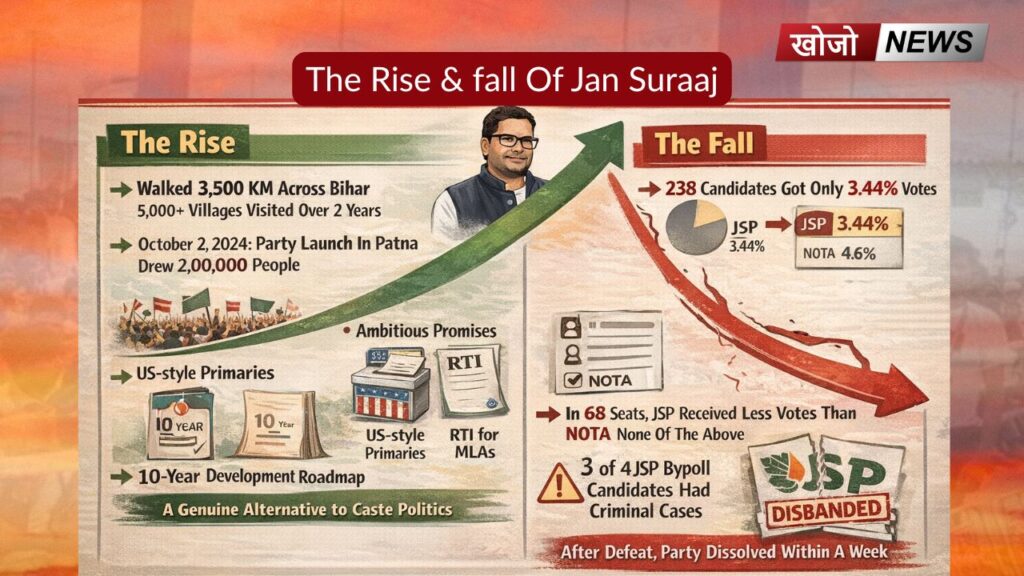
The Jan Suraaj pitch was genuinely different from anything Bihar had seen. Kishor walked 3,500 km across the state over two years — visiting 5,000+ villages, meeting farmers, students, women, daily wage workers. The party launch on October 2, 2024 drew over 2,00,000 people in Patna. The energy was real.
The promises were ambitious. US-style primary elections for candidate selection. Right to recall non-performing MLAs. 90% first-time candidates. A 10-year development roadmap built from ground-up community consultations. It sounded like a genuine alternative to Bihar’s decades-old caste-alliance politics.
Then the actual election happened. Jan Suraaj’s 238 candidates got 3.44% of votes. In 68 constituencies, JSP got fewer votes than NOTA — None of the Above. Three of its four bypoll candidates, it emerged, had criminal cases — directly contradicting PK’s core “clean candidate” promise. Within a week of results, Kishor dissolved the entire party structure from panchayat to state level.
Why It Failed — The Four Real Reasons
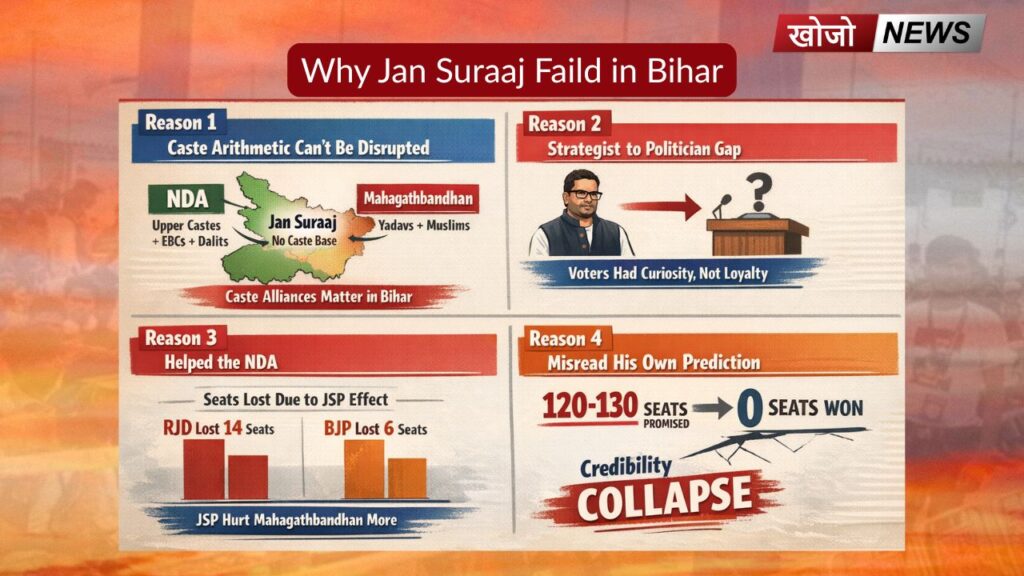
After years of covering Bihar politics, what I can tell you is this: the Jan Suraaj failure was not a surprise to anyone who understood the state. It was a surprise only to people who confused media coverage with voter sentiment.
Reason 1 — Caste arithmetic cannot be disrupted with a padyatra. Bihar elections run on caste alliances built over decades. NDA has Upper Castes + EBCs + some Dalits. Mahagathbandhan has Yadavs + Muslims. Jan Suraaj had no anchored caste group. Good governance as a message appeals to educated urban voters — who are a small minority in Bihar’s largely rural, deeply caste-conscious electorate.
Reason 2 — The strategist-to-politician transition is harder than it looks. Knowing how voters behave is not the same as being able to mobilise them for yourself. PK’s credibility was borrowed from the leaders he had elevated. Voters had no personal loyalty to him — only curiosity. Curiosity does not convert to votes at scale.
Reason 3 — Jan Suraaj accidentally helped NDA. Political analyst Rahul Verma of CPR noted that PK’s relentless attacks on Tejashwi Yadav — calling him “a Class 9 fail,” questioning his competence — effectively amplified NDA’s own campaign narrative. Jan Suraaj hurt the Mahagathbandhan more than NDA. In 34 constituencies where JSP polled more than the winning margin, RJD lost 14 seats compared to BJP’s 6.
Reason 4 — He misread his own prediction. PK publicly promised Jan Suraaj would win 120-130 seats. He said anything less was defeat. He said he’d retire if JDU won 25 seats. These were not strategic statements — they were emotional commitments that made the zero-seat result look not just like failure but like a credibility collapse.
| Category | Jan Suraaj Party (JSP) | Aam Aadmi Party (AAP) in 2013 |
|---|---|---|
| Founded | October 2024 | November 2012 |
| First Election | Bihar 2025 — 0 seats, 3.44% votes | Delhi 2013 — 28 seats, 29.5% votes |
| Founder Background | UN public health worker, election strategist | Anti-corruption activist (Anna movement) |
| Core Promise | Good governance, clean candidates, development | Anti-corruption, cheaper utilities, clean politics |
| Caste Strategy | None — explicitly caste-neutral | Delhi’s urban electorate — less caste-dependent |
| Post-first-election | Dissolved party structure, rebuilding | Formed government within months |
| Key Difference | Bihar — deeply rural, caste-entrenched electorate | Delhi — urban, educated, reform-hungry electorate |
3 Things Most Articles Miss About Jan Suraaj
1. Zero seats does not mean zero impact. In 34 Bihar constituencies, Jan Suraaj polled more votes than the winning margin. It swung actual outcomes — costing Mahagathbandhan 18 seats and NDA 15. A party that wins nothing but changes 34 results in its first election is not irrelevant. It is dangerous — just not in the way PK intended.
2. The December 21, 2025 general council meeting was the real signal to watch. After dissolving its structure in November, JSP scheduled a complete organisational rebuild review for December 21. That meeting — and whether PK maintained the party or quietly wound it down — was the clearest indicator of whether Jan Suraaj was a genuine long-term project or a single-cycle experiment. Most media coverage missed this completely.
3. PK said he would fight until 2031 — regardless of results. Before the election, Kishor publicly committed to Bihar politics for at least 10 years — until 2031. He repeated this after the results. The dissolving of party units was framed as restructuring, not surrender. Whether that commitment holds is the only question that actually matters for Jan Suraaj’s future.
For the broader context of how Bihar’s political landscape shapes national elections, read our full breakdown: How Many Indian MPs Have Criminal Cases — 2026 Data.”
FAQ — What People Are Searching About Jan Suraaj
Did Jan Suraaj Party win any seats in Bihar 2025?
No. Jan Suraaj Party contested 238 out of 243 Bihar Assembly seats in 2025 and won zero. It secured 3.44% vote share. In 68 constituencies, JSP received fewer votes than NOTA. In 236 of 238 constituencies, candidates lost their security deposits.
What is Jan Suraaj Party and who founded it?
Jan Suraaj Party (People’s Good Governance Party) was founded by Prashant Kishor on October 2, 2024 — Gandhi Jayanti — in Patna. Kishor is India’s most successful political strategist, having worked for BJP, Congress, TMC, AAP, and DMK before launching his own party focused on clean governance and development in Bihar.
Why did Jan Suraaj Party fail in Bihar?
Three main reasons: Bihar’s elections are driven by caste alliances that JSP had no anchor in; PK’s “good governance” message resonated with educated urban voters but not Bihar’s largely rural electorate; and his attacks on Tejashwi Yadav inadvertently strengthened NDA’s narrative. Senior political analysts described it as a fundamental misreading of Bihar’s caste-based political arithmetic.
Is Prashant Kishor retiring from politics after Bihar results?
He had said he would retire if JDU won 25 seats — JDU won 85. However, Kishor has publicly maintained he will continue fighting for Bihar until at least 2031, calling 2025 a “first step.” Post-election, JSP dissolved its entire organisational structure for a rebuild. Whether the party sustains or quietly winds down remains to be seen.
What is the future of Jan Suraaj Party in 2026?
Jan Suraaj has no immediate elections to contest in 2026 — Bihar’s next assembly election is in 2030. The party’s stated strategy is to spend the intervening years rebuilding grassroots organisation, identifying stronger candidates, and deepening its ground presence. Whether PK can maintain momentum and funding without an election campaign to focus energy on is the central challenge.
Here is the honest verdict on Jan Suraaj: it is not hype and it is not a real challenger — yet. It is something rarer and more interesting. It is a serious political experiment that failed its first test badly, run by a man who has spent his career proving that electoral outcomes can be engineered if you understand the variables.
The question is whether PK misread Bihar — or whether Bihar simply hasn’t finished reading PK.