
| Ban Date | July 23–25, 2025 |
| Announced By | Ministry of Information and Broadcasting (MIB), Government of India |
| Confirmed In Parliament | February 11, 2026 — Union MoS Electronics & IT Jitin Prasada, Lok Sabha |
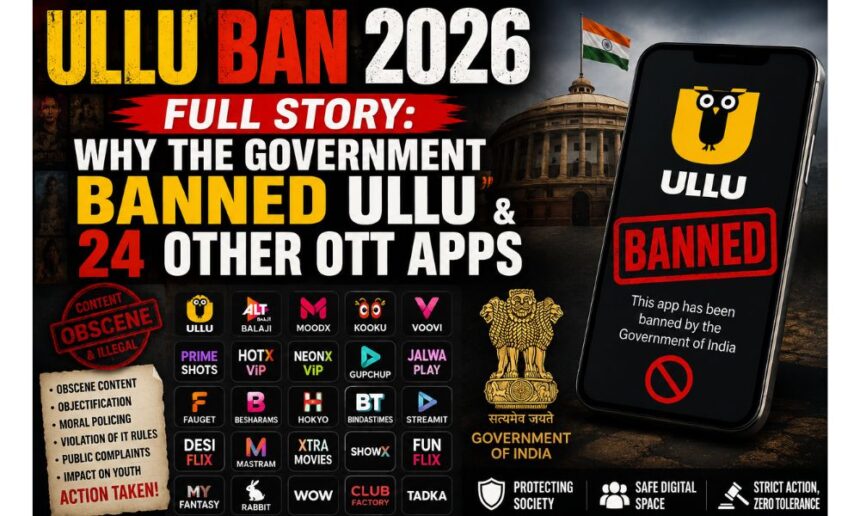
| Total Platforms Banned | 25 OTT platforms and related mobile apps |
| Key Platforms Banned | Ullu · ALTT (ALTBalaji) · BigShots · Desiflix · Boomex · MoodX · NeonX VIP · HitPrime · Feneo · Hulchul · Fugi · Mojflix · Triflicks · Hot X VIP · ShowX · Wow Entertainment · Look Entertainment · Navarasa Lite · Gulab App · Kangan App · Bull App · Jalva App · Sol Talkies · Adda TV |
| Legal Basis | IT Act 2000 Section 69A (blocking orders) · IT Act Section 67 & 67A (obscene electronic content) · IT Rules 2021 (Digital Media Ethics Code) · Bharatiya Nyaya Sanhita Section 294 (obscene acts) · Indecent Representation of Women (Prohibition) Act 1986 Section 4 |
| Ministries Consulted | Ministry of Home Affairs · Ministry of Women and Child Development · MeiTY · Department of Legal Affairs · FICCI · CII · Women’s rights and child rights experts |
| Key Regulatory Bodies | NCPCR (National Commission for Protection of Child Rights) · DPCGC (Digital Publisher Content Grievances Council) |
| Ullu Founder | Vibhu Agarwal — launched Ullu in 2018 |
| Ullu IPO Status | Filed draft red herring prospectus February 2024 (₹135–150 crore) — put on hold after NCPCR and DPCGC objections |
| Effect on Actresses | Ongoing and unreleased projects disrupted · Several major series pulled from platforms · Alternative platform pickups largely did not materialise |
On July 25, 2025, the Ministry of Information and Broadcasting issued a directive to every Internet Service Provider in India: block these 25 OTT platforms. Google and Apple received instructions to delist their apps. The ban was immediate and comprehensive. Ullu — which had filed for an IPO worth ₹135–150 crore just 18 months earlier — went dark.
- What Is Ullu — And How Big Did It Get Before the Ban?
- The Road to the Ban — A Timeline of Warnings Ignored
- The Complete List of 25 Banned OTT Platforms
- The Legal Framework — Which Laws Were Used to Ban These Platforms
- What Happened to the Actresses Who Built Their Careers on These Platforms
- 3 Things Most Coverage of the Ullu Ban Gets Wrong
- FAQ — What People Are Searching About the Ullu Ban
The government had not acted without warning. It had been warning for over a year. The platforms had not listened. What followed was one of India’s most significant digital media regulatory actions since the TikTok ban of 2020 — and it hit an ecosystem of platforms that had built audiences numbering in the tens of millions, careers for hundreds of actresses, and an advertising market that no major brand publicly acknowledged but many quietly used.
What Is Ullu — And How Big Did It Get Before the Ban?
Ullu was founded in 2018 by media entrepreneur Vibhu Agarwal — a businessman with prior experience in television, production, and the health and wellness industry who also founded a steel company called JAYPEECO. The platform launched into an OTT market that Netflix and Amazon Prime Video had opened up but had not exploited in the direction Ullu chose to go: bold, adult-adjacent content for a mass Hindi-speaking audience in Tier 2 and Tier 3 cities who could not find their preferred content on mainstream platforms.
The strategy worked. Ullu grew from a startup to one of India’s most-downloaded OTT apps. Its subscriber base ran into millions. Its content — Charmsukh, Palang Tod, Kavita Bhabhi, Dunali — became the most-searched web series titles on Google in their target demographic. In February 2024, Ullu Digital Ltd filed a draft red herring prospectus to raise ₹135–150 crore through an IPO — what would have been one of India’s largest MSME OTT listings. At that point, the platform appeared to be heading toward institutional legitimacy.
It never got there. Within a year, the NCPCR had flagged it repeatedly, the IPO had been put on hold, and the MIB had run out of warnings to issue.
📌 External Link 1: Link “Ministry of Information and Broadcasting” to mib.gov.in — for readers who want to access the official government communication on the ban directly.
The Road to the Ban — A Timeline of Warnings Ignored
The July 2025 ban was not a sudden regulatory crackdown. It was the conclusion of a 16-month escalation that the platforms collectively chose not to take seriously.
March 2024 — First Blocking Action: The government blocked five OTT platforms in March 2024 for obscene content violations. The platforms did not shut down. Instead, they migrated to new website domains and continued publishing the same content. That response — treating a government blocking order as a minor technical obstacle — set the tone for everything that followed.
July–August 2024 — NCPCR Flags Ullu and ALTT: The National Commission for Protection of Child Rights formally flagged Ullu and ALTT for content violations — specifically concerning explicit material and content depicting inappropriate sexual situations involving family relationships. The NCPCR’s involvement was significant: child protection bodies carry political weight that obscenity complaints alone do not.
September 2024 — Official Warning to All 25 Platforms: The MIB sent official communications to all 25 platforms that would eventually be banned, instructing them to cease transmitting obscene, vulgar, and pornographic content. All 25 received the warning. None made substantive changes.
February 2025 — Government Advisory Under IT Rules 2021: The Ministry issued a formal advisory under the IT Rules 2021 urging OTT platforms to comply with India’s obscenity laws and the Code of Ethics. This was the last formal warning before regulatory action. The platforms continued to publish objectionable content.
May 2025 — Ullu Pulls House Arrest: Following MIB intervention specifically targeting the series House Arrest (which starred controversial figure Ajaz Khan), Ullu took the series down. The removal was partial, temporary, and — in the government’s assessment — not representative of any genuine content policy change.
July 23–25, 2025 — The Ban: MIB issued blocking orders to ISPs. Google and Apple received delisting instructions. All 25 platforms went dark for Indian users simultaneously.
The Complete List of 25 Banned OTT Platforms
| # | Platform Name | Notes |
|---|---|---|
| 1 | Ullu (Ullu Digital Ltd) | Founded by Vibhu Agarwal · India’s largest banned bold OTT platform · IPO put on hold |
| 2 | ALTT (ALTBalaji) | Owned by Ekta Kapoor’s Balaji Telefilms · mainstream OTT turned adult content · Gandii Baat, DevDD |
| 3 | BigShots App | Significant actress presence including Tejashwini Prabhakar Gowda |
| 4 | Desiflix | Bold OTT platform — significant subscriber base |
| 5 | Boomex | Bold OTT — multiple actress credits |
| 6 | MoodX | Significant platform — Ritu Pandey Jamuniya (IMDb 8.4), Andha Sasur |
| 7 | NeonX VIP | Bold OTT short-format content platform |
| 8 | HitPrime | Mid-size platform — multiple actress credits including Ritu Pandey |
| 9 | Feneo Movies | Long-established bold OTT — Rekha Mona Sarkar credits |
| 10 | Hulchul App | Bold OTT — Jonita D’Cruz credits |
| 11 | Hot X VIP | Adult content streaming app |
| 12 | ShowX | Bold OTT platform |
| 13 | Wow Entertainment | Bold OTT platform — WOW Originals (Jayshree Gaikwad credits) |
| 14 | Look Entertainment | Bold OTT platform |
| 15 | Navarasa Lite | Regional bold OTT |
| 16 | Gulab App | Bold OTT platform |
| 17 | Kangan App | Bold OTT platform |
| 18 | Bull App | Bold OTT — multiple actress credits including Jonita D’Cruz |
| 19 | Jalva App | Bold OTT platform |
| 20 | Sol Talkies | Bold OTT platform |
| 21 | Adda TV | Bold OTT platform |
| 22 | Fugi | Bold OTT platform |
| 23 | Mojflix | Bold OTT platform |
| 24 | Triflicks | Bold OTT platform |
| 25 | Adda TV (variant listing) | Platform variant — confirmed in official lists |
The Legal Framework — Which Laws Were Used to Ban These Platforms
The ban was not an emergency executive action — it was executed under existing Indian law using five distinct legal provisions simultaneously.
Section 69A of the IT Act, 2000: Empowers the government to issue blocking orders to ISPs and intermediaries for content that threatens national security, public order, or decency. This is the same provision used to ban TikTok in 2020 and block Chinese apps after the Galwan Valley conflict. Applying it to OTT content platforms set a significant regulatory precedent.
Sections 67 and 67A of the IT Act, 2000: Specifically address the distribution of obscene electronic content. Section 67A specifically targets content depicting sexually explicit acts — the provision most directly applicable to the explicit content these platforms hosted.
IT (Intermediary Guidelines and Digital Media Ethics Code) Rules, 2021: Established the regulatory framework for OTT content in India, requiring platforms to follow a Code of Ethics and implement content classification, grievance redressal, and self-regulation mechanisms. The platforms’ failure to comply despite repeated warnings under these Rules is the central basis for the ban.
Bharatiya Nyaya Sanhita Section 294: The provision on obscene acts and songs — applied to the platforms’ public-facing content streaming.
Indecent Representation of Women (Prohibition) Act, 1986, Section 4: A 1986 law that prohibits indecent representation of women in advertisements, publications, and other media — applied to the platforms’ content that depicted women in degrading or objectifying contexts without meaningful narrative purpose.
What Happened to the Actresses Who Built Their Careers on These Platforms
The ban’s most immediate human impact fell on the hundreds of actresses who had built their professional careers on the 25 banned platforms. Jayshree Gaikwad, Rekha Mona Sarkar, Kamalika Chanda, Ritu Pandey, Muskaan Agarwal, Ridhima Tiwari, Jonita D’Cruz, Tejashwini Prabhakar Gowda, Sharanya Jit Kaur, Paromita Dey — the actress profiles we have published in this series — all have credits on platforms that are now inaccessible in India.
Productions that were in post-production at the time of the ban could not release. Series that had completed filming had no platform to go to — most alternative OTT platforms declined to pick up bold content that had been specifically named in government ban proceedings. Instagram followings remained — Ridhima Tiwari’s 5 million followers, Ritu Pandey’s 800,000 followers, Jayshree Gaikwad’s loyal audience — but the content delivery mechanism for new work was gone.
The actresses who had diversified across mainstream OTT (Amazon Prime, SonyLIV, ZEE5, Disney+ Hotstar) had the most resilience. Paromita Dey’s Hostel Daze credit on Amazon Prime remained active. Anjali Anand’s Netflix Dabba Cartel was unaffected. The actresses whose entire portfolio was concentrated on Ullu and its banned peers had no equivalent alternative.
3 Things Most Coverage of the Ullu Ban Gets Wrong
1. This was not a sudden or arbitrary decision — it was 16 months of escalating warnings that the platforms collectively chose to ignore. The narrative of “government suddenly bans OTT platforms” misrepresents the timeline. March 2024 blockings. NCPCR flags in July-August 2024. September 2024 formal warning to all 25. February 2025 advisory. May 2025 individual content intervention. Then the July 2025 ban. The platforms had multiple opportunities to comply. They chose not to. The regulatory response was proportionate to the escalation.
2. ALTBalaji’s inclusion is more significant than Ullu’s — and almost nobody wrote about it that way. Ullu was always expected to be in any content crackdown. ALTBalaji was founded by Ekta Kapoor, daughter of Jeetendra, one of Bollywood’s most celebrated producers. It had mainstream industry credibility that Ullu never possessed. The fact that Balaji Telefilms’ OTT division ended up in the same banned list as Ullu — for content including Gandii Baat and Ghapa Ghap — is a bigger institutional story than Ullu’s ban. The mainstream entertainment media largely avoided this framing.
3. The five platforms that evaded the March 2024 block by migrating to new domains set the precedent that made the July 2025 ban inevitable. When the government blocked five platforms in March 2024 and those platforms simply moved to new URLs and kept publishing, the government had two options: accept that blocking orders are meaningless, or escalate to ISP-level blocking with app store delisting. The July 2025 action was the escalated response to that demonstrated evasion. The platforms that evaded the March 2024 block are directly responsible for the severity of what followed.
For biographies of actresses whose careers were directly affected by the Ullu ban, read: Jayshree Gaikwad — Age, Web Series List & Full Biography 2026.”
For the complete roundup of India’s bold OTT actress careers: Plus Size Web Series Actresses India — Wiki & Biography 2026.”
FAQ — What People Are Searching About the Ullu Ban
Why was Ullu banned in India?
The Government of India banned Ullu and 24 other OTT platforms on July 23–25, 2025 for streaming content deemed obscene, vulgar, and in some cases pornographic. The Ministry of Information and Broadcasting cited violations of Section 67 and 67A of the IT Act 2000, the IT Rules 2021 Digital Media Ethics Code, and the Indecent Representation of Women (Prohibition) Act 1986. The platforms had received multiple official warnings since September 2024 but continued to publish objectionable content. The NCPCR had flagged Ullu specifically for content violations in July and August 2024.
Which 25 OTT platforms were banned?
The 25 banned OTT platforms are: Ullu, ALTT (ALTBalaji), BigShots App, Desiflix, Boomex, Navarasa Lite, Gulab App, Kangan App, Bull App, Jalva App, Wow Entertainment, Look Entertainment, HitPrime, Feneo, ShowX, Sol Talkies, Adda TV, Hot X VIP, Hulchul App, MoodX, NeonX VIP, Fugi, Mojflix, and Triflicks. Internet service providers were directed to block all these platforms and Google and Apple were instructed to delist their apps from Indian app stores.
Is Ullu permanently banned in India?
As of May 2026, Ullu remains blocked in India under the MIB’s July 2025 directive. The ban was confirmed in Parliament on February 11, 2026 by Union MoS Electronics and IT Jitin Prasada. No official unban or reinstatement order has been publicly announced. Some users have reported accessing Ullu and similar platforms through VPNs, which is legally ambiguous under Indian law. The platform has not publicly announced a comeback date or a content compliance agreement with the government.
Was ALTBalaji (ALTT) also banned?
Yes. ALTT — formerly known as ALTBalaji, Ekta Kapoor’s Balaji Telefilms OTT platform — was included in the 25 banned platforms. The platform had attracted scrutiny for bold content including Gandii Baat, DevDD, and Ghapa Ghap. The inclusion of a platform associated with one of Bollywood’s most established production houses in the same ban as Ullu was one of the more significant elements of the July 2025 regulatory action.
What happened to actresses who had upcoming shows on Ullu when it was banned?
Actresses with upcoming productions on Ullu and the other 24 banned platforms faced immediate disruption. Projects in post-production could not release. Series in production had to be suspended. Alternative mainstream OTT platforms largely did not pick up content from banned platforms. Actresses who had diversified across mainstream platforms (Amazon Prime, Netflix, SonyLIV) were less affected. Those whose entire portfolio was concentrated on the banned platforms lost their primary income source and content delivery mechanism simultaneously.
India’s bold OTT ecosystem grew from zero to millions of users between 2018 and 2024. It built careers for hundreds of actresses, a subscription revenue market worth hundreds of crore, and an audience that mainstream platforms had not reached and did not intend to serve. Then, between March 2024 and July 2025, a regulatory process that the platforms repeatedly chose not to take seriously concluded in the most comprehensive digital content crackdown India had seen since the TikTok ban.
The government gave 16 months of warnings. The platforms gave 16 months of evasion. The outcome was predictable once the evasion became documented. Whether the ecosystem rebuilds — on compliant platforms, with moderated content, under a sustainable regulatory framework — is the story of 2026 and beyond. The ban is the ending of one chapter. What replaces it is still being written.