
| Event | Cockroach Janta Party (CJP) protest at Jantar Mantar, New Delhi |
| Date | June 6, 2026 |
| Core Demand | Resignation of Union Education Minister Dharmendra Pradhan over alleged exam paper leaks and irregularities |
| Movement Founder | Abhijeet Dipke — 30-year-old political communications strategist, former AAP volunteer |
| Movement Founded | May 16, 2026 |
| Origin | Response to CJI Surya Kant’s May 15, 2026 remark comparing unemployed youth to “cockroaches” |
| First Press Conference | June 3, 2026 — spokespersons Saurav Das, Vijeta Dahiya, Ashutosh Ranka |
| Online Scale | 350,000+ sign-ups · 20 million+ Instagram followers (in under three weeks) |
| ECI Status | Not registered as a political party |
| Nature | Satirical youth movement turned street activism |
On May 15, 2026, the Chief Justice of India, Surya Kant, compared India’s unemployed youth to “cockroaches” during a Supreme Court hearing. By 6 AM the next morning, a 30-year-old political communications strategist named Abhijeet Dipke had opened a social media account, written a short founder’s note, and named a movement after the insult. Within 72 hours, it had over 100,000 registered members. Within three weeks, it had 20 million Instagram followers — at one point reportedly outpacing the BJP’s own Instagram growth.
- What Is the Cockroach Janta Party? The Origin of an Insult Reclaimed
- Who Is Abhijeet Dipke? The Man Behind the Movement
- The June 6 Protest — What Is Actually Planned
- Who Is Joining the Movement? The Coalition Taking Shape
- The Criticism & The Cautions
- 3 Things Most Coverage of the CJP Protest Misses
- FAQ — What People Are Searching About the June 6 CJP Protest
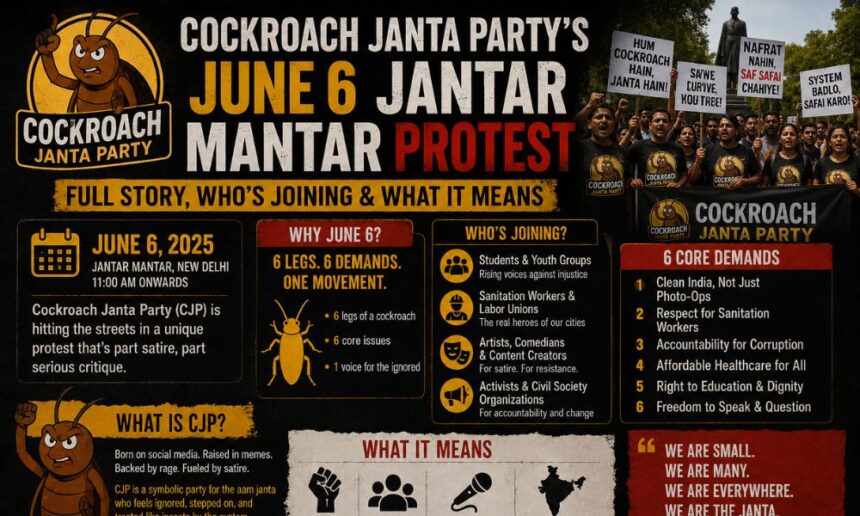
On June 6, 2026, that internet phenomenon steps into the physical world for the first time. The Cockroach Janta Party is holding a protest at Jantar Mantar in New Delhi, demanding the resignation of Union Education Minister Dharmendra Pradhan over alleged exam paper leaks. It is the moment a viral joke tries to become a real movement — and the entire country is watching to see whether memes can translate into bodies on the ground.
What Is the Cockroach Janta Party? The Origin of an Insult Reclaimed
The Cockroach Janta Party (CJP) is a satirical youth political movement founded on May 16, 2026 — and its name is the entire story of how it began.
On May 15, 2026, during a Supreme Court hearing reportedly concerning fake law degrees, Chief Justice of India Surya Kant made a remark comparing India’s unemployed youth to “cockroaches” and “parasites of society.” The clip went viral within hours, striking a nerve with millions of young Indians already frustrated by unemployment, exam irregularities, and a sense of being dismissed by the country’s institutions.
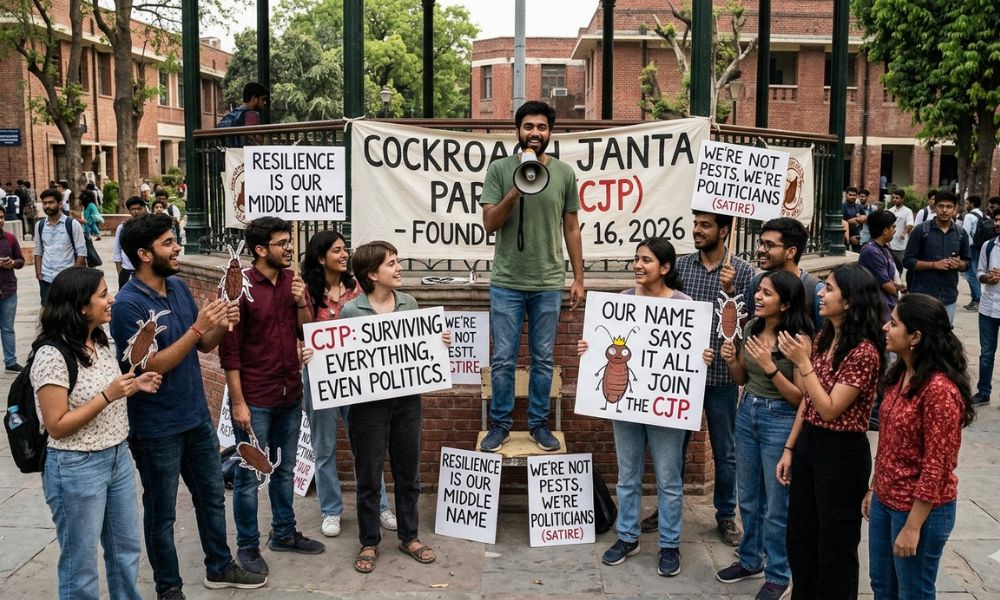
Abhijeet Dipke’s response was to do something counterintuitive: instead of rejecting the insult, he embraced it. He named his movement the Cockroach Janta Party — a deliberate parody of the ruling Bharatiya Janata Party — and turned “cockroach” from a slur into a symbol of resilience. The logic was simple and powerful: if the system sees certain young people as invisible, unwanted pests, then they would reclaim that identity and turn it into political expression. Cockroaches, after all, are famous for surviving anything.
The party’s tagline — “Voice of the Lazy & Unemployed” — leans fully into the satire. Volunteers have appeared at clean-up drives and protests dressed in cockroach costumes. It brands itself as “a political party for the people the system forgot to count.” What began as a meme had, within days, become a genuine outlet for a generation’s political frustration.
Who Is Abhijeet Dipke? The Man Behind the Movement
The founder of the Cockroach Janta Party is Abhijeet Dipke — a 30-year-old political communications strategist whose background explains a great deal about how the movement scaled so fast.
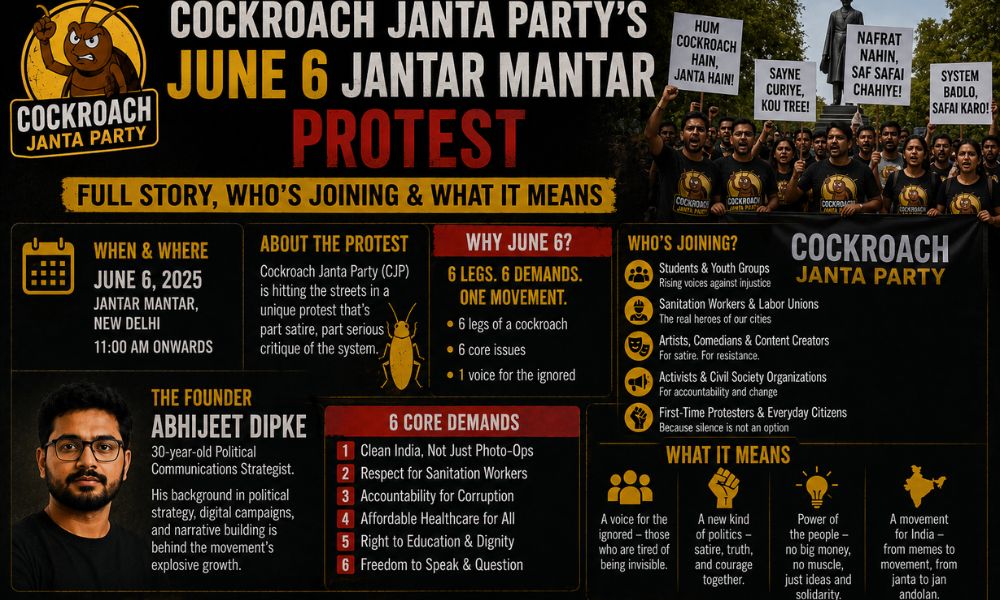
Dipke is a Boston University graduate who previously volunteered with the Aam Aadmi Party’s social-media team between roughly 2020 and 2023 before leaving. That experience — working inside the digital operation of a party that itself rose from an anti-corruption movement to power — gave him a practical understanding of how online energy converts into political organisation. The CJP’s explosive social-media growth is not entirely accidental; it reflects a strategist who knows how the machinery works.
In May 2026, Dipke publicly identified himself as Dalit on social media. Following the disclosure, he faced a wave of caste-based abuse targeting his identity. The Cockroach Janta Party has explicitly rejected caste discrimination, adopting the principle of “no caste line, no party line” — but Dipke’s decision to own his identity publicly added a personal dimension to a movement that is fundamentally about who Indian society chooses to count and who it dismisses.
His emergence has not been without legal and political turbulence. Viral claims about his deportation from the US circulated (he has said he expects to be arrested on return to India), and a BJP worker in Karnataka filed a PIL in the Allahabad High Court seeking SIT, NIA, and ED investigations into alleged foreign funding — a petition the court declined to entertain on jurisdictional grounds, after which it was withdrawn. The legal scrutiny itself signals how seriously the establishment is taking a movement that started as a joke.
The June 6 Protest — What Is Actually Planned
The June 6 Jantar Mantar protest marks the Cockroach Janta Party‘s transition from online satire to offline activism — a transition the movement officially announced at its first-ever press conference on June 3, 2026.
At that press conference, three spokespersons — Saurav Das, Vijeta Dahiya, and Ashutosh Ranka — laid out the movement’s plans and pitch. Saurav Das framed the core demand directly: “We seek minimum accountability from this system where rot has set in.” The central demand of the protest is the resignation of Union Education Minister Dharmendra Pradhan, held responsible by the movement for the recent examination leak and broader irregularities in India’s competitive exam system.
The choice of Jantar Mantar is significant. Located close to Parliament, it is the designated protest site in central Delhi and has hosted some of independent India’s most consequential demonstrations — from the anti-corruption movement to farmers’ protests to the 2012 anti-rape demonstrations. By choosing Jantar Mantar, the CJP is placing itself, symbolically, in the lineage of India’s major civic protests rather than treating June 6 as a one-off stunt.
The exam-leak issue is the perfect cause for this movement. The “cockroach” insult was about unemployed youth; exam irregularities are precisely the mechanism by which young Indians feel cheated out of fair employment opportunities. The demand for Dharmendra Pradhan’s resignation connects the abstract grievance (being dismissed by the system) to a concrete, nameable target (the minister responsible for the exams).
Who Is Joining the Movement? The Coalition Taking Shape
The most-watched question about June 6 is not whether the CJP shows up — it is who shows up with them. The composition of the crowd will determine whether this is a student protest or a broader movement.
Students and Gen-Z youth (the core base): The movement’s foundation is India’s frustrated student and young-graduate population. A linked body, the Cockroach Students’ Union of India (CSUI), has formed as part of the wider movement, supporting student participation in politics, affordable education, transparency in recruitment exams, mental health awareness, and youth representation in governance. These are the people the “cockroach” remark was aimed at, and they are the protest’s guaranteed attendees.
Farmers and Nihang Sikh groups (the viral question): A video circulating on social media has claimed that farmers and Nihang Sikh groups may join the June 6 demonstration, possibly turning it into a two-day dharna. This has raised significant attention — and some apprehension — about the protest’s scale. Crucially, the CJP itself has not officially announced a multi-day sit-in or confirmed which specific farmer groups would participate. The farmer-participation claim remains, as of now, an unverified viral rumour rather than a confirmed alliance. If true, it would dramatically expand the protest beyond its student base and connect it to India’s most organisationally experienced protest networks.
Opposition sympathy (the political dimension): The CJP has issued a “Five-Point Agenda for 2029” and called on opposition party leaders, supporters, and social activists to back it — explicitly excluding the BJP. This positions the movement as broadly anti-establishment and opposition-friendly without formally aligning with any single party. Various public figures have expressed support, though the movement has been careful to maintain its independent, satirical identity rather than becoming an arm of any existing party.
The Criticism & The Cautions
Not everyone sympathetic to the movement’s goals is convinced that a June 6 protest is the right step — and the cautions are worth taking seriously.
Sarthak Siddhant — a whistleblower associated with a CBSE exam-irregularity disclosure — offered a notably measured warning, suggesting that internet activism has value but cautioning the CJP and Dipke about the gap between online momentum and sustained real-world organising. The implicit concern is one that has haunted many viral movements: a massive online following does not automatically translate into disciplined, effective, lasting activism.
The movement has also faced a misogyny allegation, with critics noting its leadership has been overwhelmingly male — raising questions about whether a movement claiming to represent all of India’s forgotten youth adequately includes young women in its decision-making structure.
And there is the establishment pushback already described: the PIL seeking central-agency investigations, the viral deportation claims, the legal scrutiny of funding. These pressures will intensify if June 6 succeeds — and the movement’s ability to withstand them, rather than its ability to go viral, will determine whether it survives past the summer.
3 Things Most Coverage of the CJP Protest Misses
1. This is fundamentally a test of whether Indian online movements can convert to offline power — and the AAP precedent looms over everything. Abhijeet Dipke is a former AAP digital volunteer, and the Aam Aadmi Party is the one Indian example of an anti-corruption movement that became a governing party. The CJP’s entire trajectory invites the comparison: can a movement born from public anger translate viral attention into real political force? June 6 is the first data point. If a movement with 20 million followers can only produce a few hundred protesters, the “online-to-offline” conversion problem will have claimed another victim. If it produces thousands, the calculus of Indian politics shifts.
2. The “cockroach” branding is a masterstroke of political communication that most coverage treats as a gimmick. Reclaiming a slur is one of the oldest and most powerful moves in protest history. By taking the CJI’s dismissive insult and wearing it — literally, in costumes — the movement did three things at once: it neutralised the insult’s power to wound, it created an instantly recognisable and meme-able identity, and it forced the establishment into the absurd position of arguing against “cockroaches.” A strategist with AAP-era communications experience knew exactly what he was doing. The name is not a joke; it is the strategy.
3. The farmer-participation rumour is the single most important variable for June 6 — and it remains unconfirmed. India’s farmer movements possess something the CJP does not: decades of protest infrastructure, logistical capacity, and the proven ability to sustain demonstrations for months. If farmers and Nihang Sikh groups genuinely join, June 6 becomes a different and far larger event, linking Gen-Z digital anger to India’s most battle-tested protest networks. But the CJP has not confirmed it, and treating the viral video as fact would be a mistake. Whether that alliance is real is the question that determines whether June 6 is a footnote or a turning point.
For more on the movement’s origins, leadership, and manifesto, read: Cockroach Janta Party Explained — Founder, Manifesto & Why It Went Viral.”
FAQ — What People Are Searching About the June 6 CJP Protest
What is the Cockroach Janta Party protest on June 6?
The Cockroach Janta Party (CJP) is holding a protest on June 6, 2026, at Jantar Mantar in New Delhi, demanding the resignation of Union Education Minister Dharmendra Pradhan over alleged examination leaks and irregularities in India’s competitive exam system. It is the first major offline demonstration by the CJP, a satirical youth movement founded on May 16, 2026, that has gained over 20 million Instagram followers. The movement announced the protest at its first press conference on June 3, 2026.
Who founded the Cockroach Janta Party?
The Cockroach Janta Party was founded by Abhijeet Dipke, a 30-year-old political communications strategist and Boston University graduate who previously volunteered with the Aam Aadmi Party’s social-media team. He launched the movement on May 16, 2026, the morning after Chief Justice of India Surya Kant compared unemployed youth to “cockroaches” in a Supreme Court hearing. Dipke has publicly identified himself as Dalit and serves as the movement’s National Convenor.
Why is the Cockroach Janta Party demanding Dharmendra Pradhan’s resignation?
The CJP is demanding the resignation of Union Education Minister Dharmendra Pradhan over alleged paper leaks and irregularities in India’s competitive examinations. The movement frames exam irregularities as a core injustice against young Indians — the mechanism by which youth feel cheated out of fair employment. Spokesperson Saurav Das said the movement seeks “minimum accountability from this system where rot has set in.” The exam issue connects directly to the youth-unemployment frustration that gave rise to the movement.
Are farmers joining the June 6 Jantar Mantar protest?
This remains unconfirmed. A video circulating on social media has claimed that farmers and Nihang Sikh groups may join the June 6 demonstration, possibly extending it into a two-day dharna. However, the Cockroach Janta Party has not officially announced any multi-day sit-in or confirmed which farmer groups would participate. As of now, the farmer-participation claim is an unverified viral rumour rather than a confirmed alliance — though if true, it would significantly expand the protest’s scale.
Is the Cockroach Janta Party a registered political party?
No. The Cockroach Janta Party is not registered as a political party with the Election Commission of India. It describes itself as a satirical youth movement rather than a conventional political party, campaigning against broader societal, economic, and political issues affecting Indian youth — particularly unemployment, exam irregularities, and institutional elitism. It has, however, issued a “Five-Point Agenda for 2029,” suggesting longer-term political ambitions.
The Cockroach Janta Party began as a joke at 6 AM on May 16, 2026 — one frustrated strategist’s response to a Chief Justice’s insult. Three weeks later, it has 20 million followers and is about to test whether any of that translates into people standing together at Jantar Mantar. June 6 is the day the meme either becomes a movement or proves the skeptics right.
Whatever happens, the CJP has already revealed something real: a generation of young Indians who feel dismissed, uncounted, and cheated by a system that called them cockroaches — and who found, in that insult, a banner to gather under. Whether June 6 draws a few hundred or many thousands, whether farmers join or stay home, whether the movement survives the legal pressure or fades like so many viral moments before it, the underlying frustration is not going away. The system tried to call them pests. June 6 is their answer.