

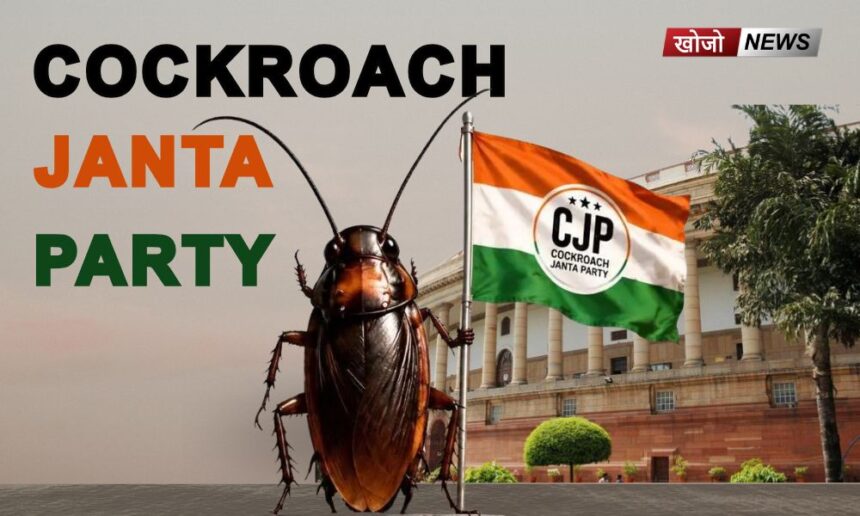
| Full Name | Cockroach Janta Party (CJP) — कॉकरोच जनता पार्टी |
| Literal Meaning | Cockroach People’s Party |
| Type | Satirical online political movement |
| Founded | May 16, 2026 |
| Founder | Abhijeet Dipke — 30-year-old public relations graduate, Boston University · former AAP social media strategist |
| Trigger Event | Chief Justice of India Surya Kant’s “cockroach” remark — May 15, 2026 — during a Supreme Court hearing |
| Sign-Ups (3 days) | 1 lakh (100,000) members by May 18, 2026 |
| X (Twitter) Followers | 37,000+ as of May 19, 2026 |
| Instagram Followers | 12,000+ as of May 19, 2026 |
| Viral TMC Connection | Two TMC MPs joined the CJP |
| Slogan | “Main Bhi Cockroach” (I Am Also A Cockroach) |
| Self-Description | “A political party for the people the system forgot to count. Five demands. Zero sponsors. One large, stubborn swarm.” |
| Ideological Position | “Secular, Socialist, Democratic, and Lazy” |
| Website | cockroachjantaparty.org |
| Electoral Ambition | Considering contesting Bankipur Assembly by-election in Bihar — vs BJP and Jan Suraaj |
| Opposition Party | National Parasitic Front — a counter-satirical movement launched in response to CJP |
On May 15, 2026, Chief Justice of India Surya Kant was hearing a Supreme Court case about fake professional credentials. He was making a point about fraud degree holders who enter professions illegally. What came out of his mouth, however, was this: “There are youngsters like cockroaches, who don’t get any employment or have any place in profession. Some of them become media, some of them become social media, RTI activists and other activists, and they start attacking everyone.”
- The Remark That Started Everything — CJI Surya Kant’s “Cockroach” Comment
- Who Is Abhijeet Dipke — The Founder
- The CJP Manifesto — Five Demands, Zero Sponsors
- The Viral Spread — From X to Yamuna to Parliament
- The Bankipur By-Election — From Satire to Real Electoral Politics?
- 3 Things Most Coverage of the CJP Misses
- FAQ — What People Are Searching About Cockroach Janta Party
By May 18, 2026 — three days later — one lakh Indians had signed up for the Cockroach Janta Party. Two TMC MPs had joined. Youth volunteers were cleaning the Yamuna river dressed in cockroach costumes. A party website, a five-point manifesto, a party anthem, and a counter-party called the National Parasitic Front had all been created. And Abhijeet Dipke — a 30-year-old PR graduate from Boston who had started it as a casual joke on X — had barely slept.
The Remark That Started Everything — CJI Surya Kant’s “Cockroach” Comment
The Supreme Court of India was hearing a case on May 15, 2026 involving individuals who had used fake or fraudulent degrees to enter professions including law and media. Chief Justice Surya Kant was expressing his frustration about the corruption of professional credentials — a legitimate judicial concern.
But the language he chose went far beyond the specific case in front of him. He said: “There are already parasites of society who attack the system. There are youngsters like cockroaches, they don’t get any employment, they don’t have any place in profession. Some of them become media, some of them become social media, some of them become RTI activists, some of them become other activists, and they start attacking everyone. And you people file contempt petitions.”
The remark landed across social media within hours. RTI activists. Social media creators. Journalists. Unemployed youth. Every category CJI Kant named felt directly targeted — and they were the exact demographics that dominate India’s digital conversation in 2026. The backlash was immediate, enormous, and — in the way that characterises India’s most effective political internet moments — immediately funny.
CJI Kant later clarified: “What I had specifically criticised were those who have entered professions like the Bar with the aid of fake and bogus degrees. Such persons have sneaked into media, social media, and other noble professions and hence they are like parasites. It is totally baseless to suggest that I criticised the youth of our nation.”
The clarification did not stop the internet. If anything, it arrived too late.
Who Is Abhijeet Dipke — The Founder

Photo:Abhijeet Dipke, founder of Cockroach Janta Party | X/@abhijeet_dipke
Abhijeet Dipke is a 30-year-old Indian student who graduated from Boston University with a degree in public relations. He is based in Chicago and is a former social media strategist for the Aam Aadmi Party — a background that gave him both the political instincts and the digital skills to turn a viral moment into a structured online movement in under 48 hours.
He told Al Jazeera from Chicago: “Those in power think citizens are cockroaches and parasites.” He told other outlets that the idea came spontaneously after he learned about the CJI’s remarks and felt that many young people wanted politics that reflected their language, humour, and frustrations. He posted on X: “What if all cockroaches come together?” — and then, when the response was overwhelming, he built the infrastructure around it.
In 72 hours, Dipke created a website, social media accounts on X and Instagram, a five-point manifesto, a party anthem, and an online sign-up system. He has said publicly he did not expect the massive response. “I barely slept,” he told Business Today. The 1 lakh sign-up milestone arrived within three days. Two sitting TMC MPs joined. Al Jazeera, Business Today, The Week, and Republic World all covered the story within 96 hours of the party’s founding.
The CJP Manifesto — Five Demands, Zero Sponsors
The Cockroach Janta Party’s manifesto is satirical in tone but specific in demands — a combination that reflects the frustration underlying the movement more than any purely comic statement could.
The party describes itself as: “A political party for the people the system forgot to count. Five demands. Zero sponsors. One large, stubborn swarm.” Its ideological self-description — “Secular, Socialist, Democratic, and Lazy” — is a direct parody of the Indian constitutional preamble’s language (“Secular, Socialist, Democratic Republic”).
The five manifesto demands as confirmed across multiple sources are:
- No Chief Justice shall receive a Rajya Sabha seat as a post-retirement reward — directly targeting what critics have long called the “judges-to-politics” pipeline that creates a conflict of interest in judicial independence.
- 50% reservation for women — a real demand that the satirical framing neither undermines nor replaces.
- Action against biased media and anchors — targeting what the youth movement identifies as partisan television journalism in India.
- A 20-year ban on political defections — addressing the anti-defection law’s failures and the frequency with which elected representatives switch parties.
- Recognition and rights for unemployed youth — the foundational demand that connects the satirical framing to the substantive economic reality of India’s youth unemployment crisis.
The Viral Spread — From X to Yamuna to Parliament
What transformed the Cockroach Janta Party from a Twitter joke into a national conversation was the combination of digital sign-ups, offline action, and political participation from sitting elected officials.
On the digital side: 1 lakh sign-ups in three days. 37,000 X followers. 12,000 Instagram followers. The hashtag #MainBhiCockroach trending nationally. A party anthem. A party poster. An official website with a manifesto.
On the physical side: a group of youth volunteers organised a cleanliness drive along the Yamuna river dressed in cockroach costumes, carrying placards. The event was framed as a peaceful protest — if cockroaches are what you call us, we’ll prove cockroaches clean up the mess you leave. The imagery generated enormous media coverage and shifted the CJP from a purely online phenomenon to a documented offline movement.
The political legitimisation came when two TMC (Trinamool Congress) MPs joined the CJP. That was not satire — that was sitting members of Parliament associating themselves with a movement launched as an internet joke. It signalled that the frustration driving the CJP resonates beyond Gen Z social media users into the mainstream political sphere.
Then came the counter-movement: the National Parasitic Front — a satirical party launched in response to the CJP, describing itself as the opposition. Business Today covered it within 24 hours of the CJP reaching national scale. The existence of a counter-party satirising the satire is arguably the clearest evidence that the CJP had reached genuine cultural momentum.
| Timeline | Event |
|---|---|
| May 15, 2026 | CJI Surya Kant’s “cockroach” remark during Supreme Court hearing on fake degrees |
| May 16, 2026 | Abhijeet Dipke announces Cockroach Janta Party on X — website, manifesto, sign-up form launched |
| May 17, 2026 | CJI Kant clarifies remarks — too late to stop the viral momentum already building |
| May 18, 2026 | 1 lakh sign-ups reached · Two TMC MPs join · Yamuna river cleanup in cockroach costumes |
| May 19, 2026 | 37K X followers · 12K Instagram followers · Al Jazeera, Business Today, The Week, Republic World coverage |
| May 20, 2026 | National Parasitic Front launches as counter-satirical “opposition party” · Bihar electoral ambition reported |
The Bankipur By-Election — From Satire to Real Electoral Politics?
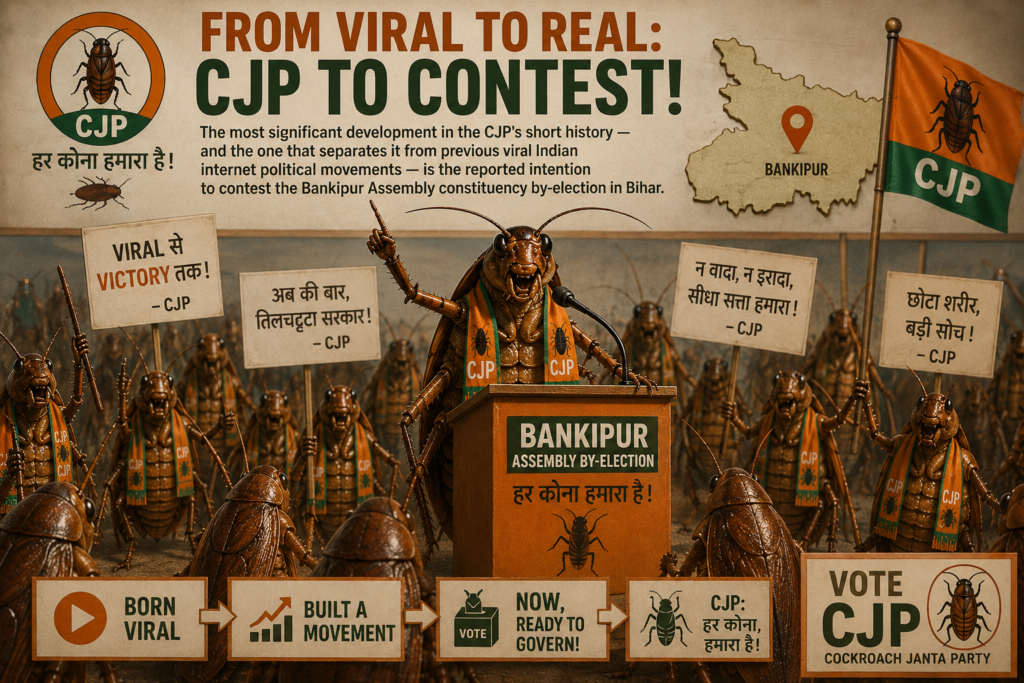
The most significant development in the CJP’s short history — and the one that separates it from previous viral Indian internet political movements — is the reported intention to contest the Bankipur Assembly constituency by-election in Bihar.
Political observers noted that the proposed candidature would place the CJP in direct contest against the Bharatiya Janata Party (BJP) and Prashant Kishor’s Jan Suraaj Party — two of Bihar’s most prominent political forces. The move was described as an attempt to expand from online activism into actual electoral politics.
In my experience covering Indian political satire movements, the graveyard of “viral protest parties” in India is extensive. The Aam Aadmi Party succeeded precisely because it converted online outrage into on-ground organisation before the outrage faded. Every other movement that tried to make the same jump — from internet to ballot box — failed because it underestimated the difference between social media momentum and electoral infrastructure. Whether the CJP has genuinely assessed that difference, or whether it will settle comfortably into being a permanent satirical institution rather than an electoral one, will determine its long-term significance.
3 Things Most Coverage of the CJP Misses
1. The founder’s AAP background is the most important biographical detail for understanding why this worked. Abhijeet Dipke was not a random social media user who got lucky. He was a former social media strategist for the Aam Aadmi Party — a party that itself emerged from the Anna Hazare anti-corruption movement and successfully converted online momentum into electoral results. He understood the mechanics of building a digital political movement from inside one that had done it. The CJP is not accidental. It is applied knowledge.
2. The five-point manifesto contains real policy demands — not just jokes. No Rajya Sabha seats for retired judges. 50% women’s reservation. Action against biased media. A 20-year anti-defection ban. Youth employment rights. These are legitimate, substantive political demands that deserve analysis on their merits. The satirical packaging has made most mainstream media cover the CJP as a viral trend rather than as a policy document. Both things are simultaneously true — and the policy demands are the part that will matter if the CJP survives its first month.
3. The National Parasitic Front’s emergence within 24 hours of CJP reaching scale is the best possible indicator of cultural resonance. When a satirical movement generates a counter-satirical movement within a day of going national, it has crossed from “trending topic” into “cultural reference point.” The CJP is now self-referential — it exists in India’s political conversation as a category, not just a campaign. That permanence, regardless of whether it contests elections or wins any, is the movement’s most durable achievement.
For more on India’s political movements and the forces shaping Indian democracy in 2026, read: Jan Suraaj — Real Political Challenger or Just Hype?“
FAQ — What People Are Searching About Cockroach Janta Party
What is the Cockroach Janta Party?
The Cockroach Janta Party (CJP — कॉकरोच जनता पार्टी) is a satirical online political movement founded on May 16, 2026 by Abhijeet Dipke, a 30-year-old former AAP social media strategist and Boston University public relations graduate. It was launched in direct response to Chief Justice of India Surya Kant’s controversial remarks on May 15, 2026 comparing unemployed youth to “cockroaches.” The movement reached 1 lakh sign-ups within three days and has a five-point manifesto addressing judicial appointments, women’s reservation, media bias, anti-defection law, and youth unemployment.
Who founded the Cockroach Janta Party?
Abhijeet Dipke — a 30-year-old Indian currently based in Chicago, who recently graduated from Boston University with a degree in public relations. He is a former social media strategist for the Aam Aadmi Party. He launched the CJP on May 16, 2026 with a casual post on X asking “What if all cockroaches come together?” — and within 72 hours had built a website, manifesto, social media presence, and an online sign-up system that reached 1 lakh members.
What did CJI Surya Kant say about cockroaches?
On May 15, 2026, during a Supreme Court hearing on a case involving fake professional degrees, Chief Justice Surya Kant said: “There are youngsters like cockroaches, who don’t get any employment or have any place in profession. Some of them become media, some of them become social media, RTI activists and other activists, and they start attacking everyone.” He later clarified that his remarks targeted people using fraudulent degrees to enter professions — not unemployed youth in general. The clarification came after the viral response had already begun.
What is the CJP manifesto?
The Cockroach Janta Party’s five-point manifesto demands: no Rajya Sabha seat for Chief Justices as post-retirement reward; 50% reservation for women; action against biased media and anchors; a 20-year ban on political defections; and recognition and rights for unemployed youth. The party describes itself as “Secular, Socialist, Democratic, and Lazy” — a parody of the constitutional preamble’s language — and its website is cockroachjantaparty.org.
Will the Cockroach Janta Party contest elections?
As of May 20, 2026, reports indicate that CJP supporters are considering fielding a candidate in the upcoming Bankipur Assembly constituency by-election in Bihar — which would place them in direct contest with the BJP and Prashant Kishor’s Jan Suraaj Party. No formal candidature has been confirmed. Political observers note the move would represent a significant transition from online satirical movement to electoral participant — a jump that most viral protest movements in India have attempted and failed to make.
The Cockroach Janta Party was born on May 15, 2026 from a Supreme Court hearing that took an unexpected turn. By May 20, it had 1 lakh members, two TMC MPs, a cleanup drive on the Yamuna, an opposition party, and international media coverage from Al Jazeera to Business Today. In five days.
Whether it contests a Bihar by-election, fades back into the internet’s archive of viral protest movements, or — in the unexpected way that Indian politics occasionally produces — becomes something more durable than anyone anticipated in week one, is a question only the next few months will answer. What is already certain is that CJI Surya Kant’s “cockroach” remark has permanently entered the vocabulary of Indian political satire. The swarm was not what he intended. It is exactly what he got.