
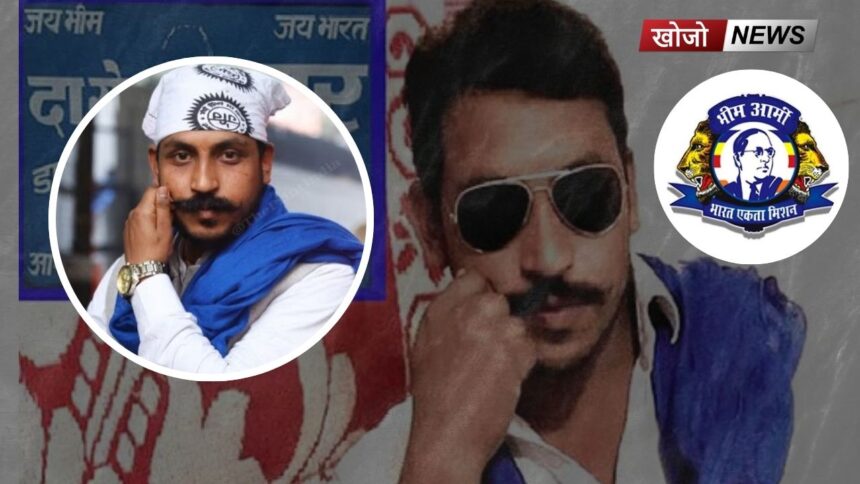
| Full Name | Chandrashekhar Azad (also known as “Ravan”) |
| Date of Birth | December 3, 1986 — Chhutmalpur, Saharanpur, Uttar Pradesh |
| Age (2026) | 39 years |
| Father | Goverdhan Das — government school principal |
| Education | BA and LLB — Garhwal University |
| Community | Dalit — Chamar sub-caste |
| Marital Status | Unmarried |
| Organisation Founded | Bhim Army Bharat Ekta Mission (2015) |
| Political Party Founded | Azad Samaj Party — Kanshi Ram (2020) |
| Current Position | MP — Nagina Lok Sabha constituency (2024 — by 1,51,473 votes) |
| Time Magazine | Featured in 100 Emerging Leaders — February 2021 |
| Core Demands (2026) | Caste census, increased reservation proportional to population, private sector reservation, old pension scheme reinstatement |
In June 2017, the Uttar Pradesh government arrested a 30-year-old Dalit lawyer from Saharanpur under the National Security Act. They held him for 16 months without trial — longer than most criminal cases take to reach court. When he finally walked out in September 2018, his follower base had tripled. His name was Chandrashekhar Azad. The arrest that was meant to silence him became the moment that made him.
- The Boy From Saharanpur — Early Life Nobody Covers
- The NSA Arrest — How a Crackdown Built a Leader
- Nagina 2024 — The Win That Changed Everything
- What He Actually Wants — The 5-Point Political Agenda
- 3 Things Most Articles Miss About Chandrashekhar Azad
- ❓ FAQ — What People Are Searching About Chandrashekhar Azad
Seven years later, he sits in Parliament as the only Dalit MP from Uttar Pradesh — the state with the largest Dalit population in India. And every major political party is quietly watching him to figure out what comes next.
The Boy From Saharanpur — Early Life Nobody Covers
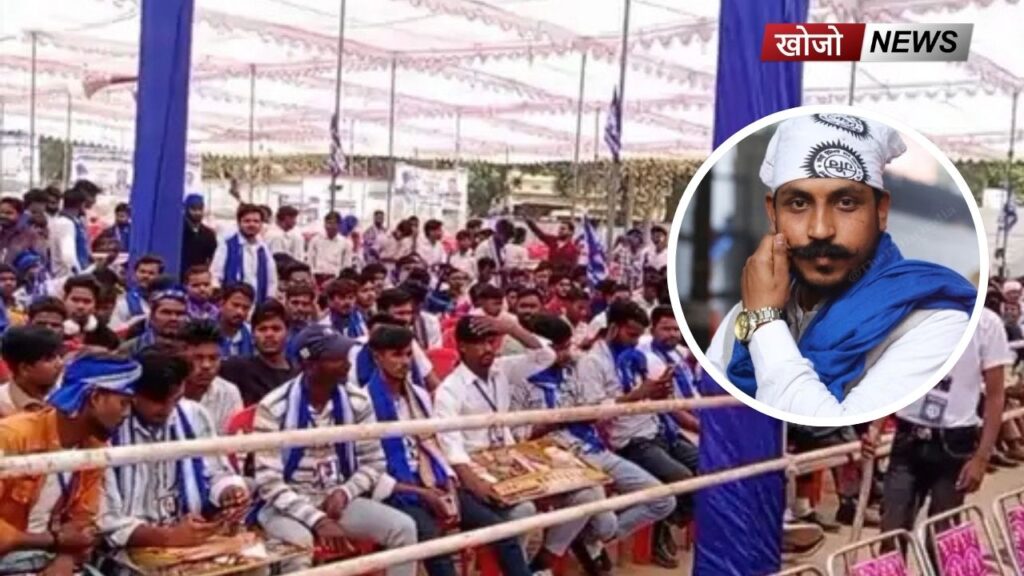
Most people get this wrong about Chandrashekhar Azad — they assume he came from political privilege or a movement family. He didn’t. He was born December 3, 1986 in Chhutmalpur village, Saharanpur district — a deeply caste-segregated belt of western Uttar Pradesh where Dalit-Thakur tensions have produced violence for generations.
His father was a government school principal — educated, disciplined, deeply invested in his children’s learning. That background gave Chandrashekhar something rare in Dalit activism: a law degree. He earned his BA and LLB from Garhwal University. Being a lawyer mattered — it gave him the language to fight back in the system’s own terms.
He co-founded the Bhim Army in 2015 with Satish Kumar and Vinay Ratan Singh. The organisation’s mission was simple and specific: run free schools for Dalit children in western UP, and physically intervene when upper-caste communities tried to humiliate Dalits in public spaces.
The intervention model was new. When upper-caste Rajputs tried to stop a Dalit groom from riding a horse to his wedding — a traditional assertion of dignity — the Bhim Army showed up and escorted him. That kind of direct action built loyalty faster than any political speech.
The NSA Arrest — How a Crackdown Built a Leader
The 2017 arrest was the government’s biggest strategic miscalculation in UP Dalit politics. After caste violence in Saharanpur’s Shabbirpur village — where upper-caste men attacked Dalit homes — Chandrashekhar organised protests. The Yogi Adityanath government arrested him under the National Security Act in June 2017.
NSA allows detention without trial for up to 12 months, extendable. They held him 16 months. The Allahabad High Court finally granted bail, calling the arrest politically motivated. But by then, Chandrashekhar had become a symbol across western UP and beyond.
In my experience covering UP politics, the government’s instinct to suppress through NSA almost always backfires with young urban Dalit voters. A criminal case can be managed. An NSA detention becomes mythology. Ambedkar was jailed. Kanshi Ram was persecuted. Now Chandrashekhar.
The followers who came to his rallies after 2018 weren’t just protesters — they were people who felt his suffering was their suffering. That emotional identification is what turns an activist into a political force.
Nagina 2024 — The Win That Changed Everything
Winning Nagina by 1,51,473 votes in 2024 was not just an electoral result. It was a demolition of the BSP’s monopoly claim over Dalit votes.
Nagina is an SC-reserved constituency in western UP. Its electorate is roughly 40% Muslim and 20% Dalit — a combination that historically voted BSP. In 2024, BSP’s candidate got just 1.33% of the vote. Chandrashekhar got 51.19%. The BSP drew a complete blank across all 80 UP Lok Sabha seats.
What nobody tells you is what this number means structurally: for the first time since Kanshi Ram built the BSP in the 1980s, there is a credible alternative claimant to Dalit political identity in Uttar Pradesh. Chandrashekhar Azad is not there yet — one Lok Sabha seat is not a movement. But the direction of travel is unmistakable.
His maiden Lok Sabha speech on July 2, 2024 set out his agenda clearly: caste census, reservation proportional to population, private sector reservation, old pension scheme reinstatement, and increased social welfare budgets. Every demand was data-backed and constitutionally framed — the instincts of a lawyer, not a street agitator.
What He Actually Wants — The 5-Point Political Agenda
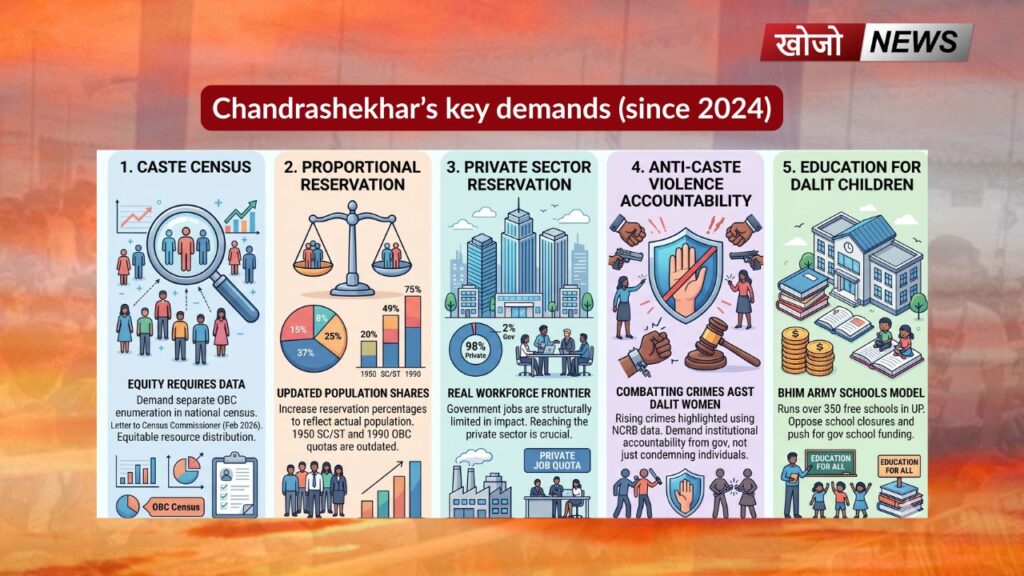
Chandrashekhar’s demands in Parliament and public speeches since 2024 cluster around five consistent themes.
Caste Census: He raised this in his maiden Lok Sabha speech and wrote formally to the Census Commissioner in February 2026, demanding OBCs be separately classified in the national census. His argument: you cannot distribute resources equitably without knowing the actual population distribution by caste. Currently, only Scheduled Tribes are separately enumerated.
Proportional Reservation: He demands that reservation percentages be increased to reflect actual population shares. The current 15% SC and 7.5% ST reservations in central government jobs were set in 1950. The Mandal Commission’s OBC reservation of 27% was established in 1990. None of these have been updated since.
Private Sector Reservation: He raised this directly in Parliament — pointing out that 98% of India’s workforce is in the private sector and only 2% in government. Reservation in government jobs, he argued, is structurally limited in impact. Reaching the private sector is the real frontier.
Anti-Caste Violence Accountability: Using NCRB data in Parliament, he highlighted rising crimes against Dalit and marginalised women — demanding institutional accountability from the government rather than only condemning individual perpetrators.
Education for Dalit Children: The Bhim Army runs over 350 free schools across UP — his pre-political governance model. He has consistently pushed for government school funding and opposed school closures in UP under the Yogi government.
| Category | Chandrashekhar Azad (ASP) | Mayawati (BSP) |
|---|---|---|
| Founded Party | Azad Samaj Party — 2020 | Bahujan Samaj Party — 1984 |
| Ideology Base | Ambedkarite — confrontational, street-level activism | Ambedkarite — electoral coalition-building |
| 2024 Lok Sabha | 1 seat — Nagina (won by 1.51 lakh votes) | 0 seats — complete blank across India |
| Dalit Sub-Caste Focus | Chamar identity — openly asserted | Pan-Dalit coalition — identity kept broad |
| Muslim Alliance | Actively courts — Nagina electorate 40% Muslim | Historically cooled — alliance patterns fragmented |
| Age (2026) | 39 — youngest major Dalit political leader | 70 — facing succession questions |
| Arrest History | NSA detention 16 months — political capital | CBI cases — political liability |
3 Things Most Articles Miss About Chandrashekhar Azad
1. He self-identifies as “Ravan” — and it is a deliberate, calculated provocation. In Hindu mainstream discourse, Ravan is the villain. For Chandrashekhar, adopting the name is an assertion: Dalit communities in South India have historically viewed Ravan as a powerful, knowledgeable figure targeted by upper-caste narrative construction. Using the name publicly is both a statement of Dalit pride and a deliberate attempt to unsettle upper-caste cultural comfort. It works.
2. His Bhim Army school network is his most durable political infrastructure — not his rallies. The 350+ free schools across UP create a direct relationship between the Bhim Army and Dalit families at the community level. Parents whose children studied in these schools become organisational loyalists in a way that rally attendees never fully become. When Chandrashekhar contested Nagina in 2024, the school network was his ground operation.
3. He is the only Dalit MP from UP — in a state that sends 80 MPs to Lok Sabha. Uttar Pradesh has India’s largest Dalit population. It elects 80 Lok Sabha MPs. Of those, exactly one is Dalit-identity led — Chandrashekhar. BSP, which built its entire brand around Dalit representation, sent zero. That structural gap is his entire political opportunity and the reason every party from BJP to SP is simultaneously trying to neutralise and court him.
“For the broader data on how marginalised communities are represented in India’s Parliament, read our full analysis: How Many Indian MPs Have Criminal Cases — 2026 Data.
❓ FAQ — What People Are Searching About Chandrashekhar Azad
Who is Chandrashekhar Azad Ravan?
Chandrashekhar Azad (born December 3, 1986) is a Dalit rights activist, lawyer, and MP from Nagina, Uttar Pradesh. He founded the Bhim Army in 2015 and the Azad Samaj Party (Kanshi Ram) in 2020. In 2024, he won the Nagina Lok Sabha seat by 1,51,473 votes — becoming the only Dalit MP from UP. Time magazine named him in its 100 Emerging Leaders list in 2021.
What is Bhim Army and what does it do?
Bhim Army (Bharat Ekta Mission) is an Ambedkarite organisation co-founded by Chandrashekhar Azad in 2015. It runs over 350 free schools for Dalit and Muslim children in UP, intervenes against caste-based violence and discrimination, and organises political protests on issues like CAA, manual scavenging, and caste atrocities. It has an estimated 20,000+ active followers in the Saharanpur region alone.
Why is Chandrashekhar Azad called Ravan?
Chandrashekhar Azad adopted the name “Ravan” as a deliberate assertion of Dalit pride. Many Dalit and Bahujan communities in India view Ravan as a historically powerful figure whose reputation was shaped by upper-caste Hindu narratives. By using the name, Chandrashekhar challenges that narrative and asserts an alternative Ambedkarite reading of Indian history and mythology.
How did Chandrashekhar Azad win Nagina in 2024?
Chandrashekhar won Nagina — an SC-reserved constituency in western UP — with 5,12,552 votes, defeating BJP’s candidate by 1,51,473 votes. Nagina’s electorate is roughly 40% Muslim and 20% Dalit. BSP’s candidate received just 1.33% of votes, indicating a massive shift of Dalit votes from BSP to ASP. His Bhim Army school network and direct-action activism served as his ground infrastructure.
What does Chandrashekhar Azad want politically in 2026?
His core demands in Parliament and public campaigns include: a caste census with separate OBC enumeration, reservation percentages updated to match actual population shares, extension of reservation to the private sector, reinstatement of the old pension scheme for government employees, increased budgets for SC/ST welfare schemes, and stronger accountability for caste-based violence against Dalit women.
Chandrashekhar Azad is not Mayawati’s heir. He is not a BSP rival. He is something structurally different — an Ambedkarite politician who built his credibility through direct community action before he ever contested an election, who went to jail for it, and who emerged with a voter base that no party fully controls or can easily poach.
At 39, with one Lok Sabha seat and 350 schools, he is still in the opening chapter. The question that keeps every UP political strategist awake at night is not whether he matters now — it is what happens when he has ten seats instead of one.